
Aztec Architecture Explained: Where Zero-Knowledge Meets Smart Contracts
Understanding Privacy-First Smart Contracts on Ethereum

Ethereum is transparent by default.
Anyone can see your balance, transactions, and smart contract interactions.
Aztec changes that.
Aztec is a privacy-first Layer 2 network built on Ethereum that allows users to send transactions and execute smart contracts privately, while still inheriting Ethereum’s security.
Instead of publishing transaction details on-chain, Aztec uses zero-knowledge proofs to prove that transactions are valid without revealing any private information.
Why do we even need Aztec?
On Ethereum today, your wallet balance is public, your transaction history is public and all your DeFi activity is public. This is great for transparency, but terrible for privacy.
Aztec introduces confidentiality for:
Transfers
Smart contract calls
Application logic
without sacrificing decentralization or security.
TL;DR: Aztec is a private execution layer that securely settles on Ethereum.
High-Level Architecture:
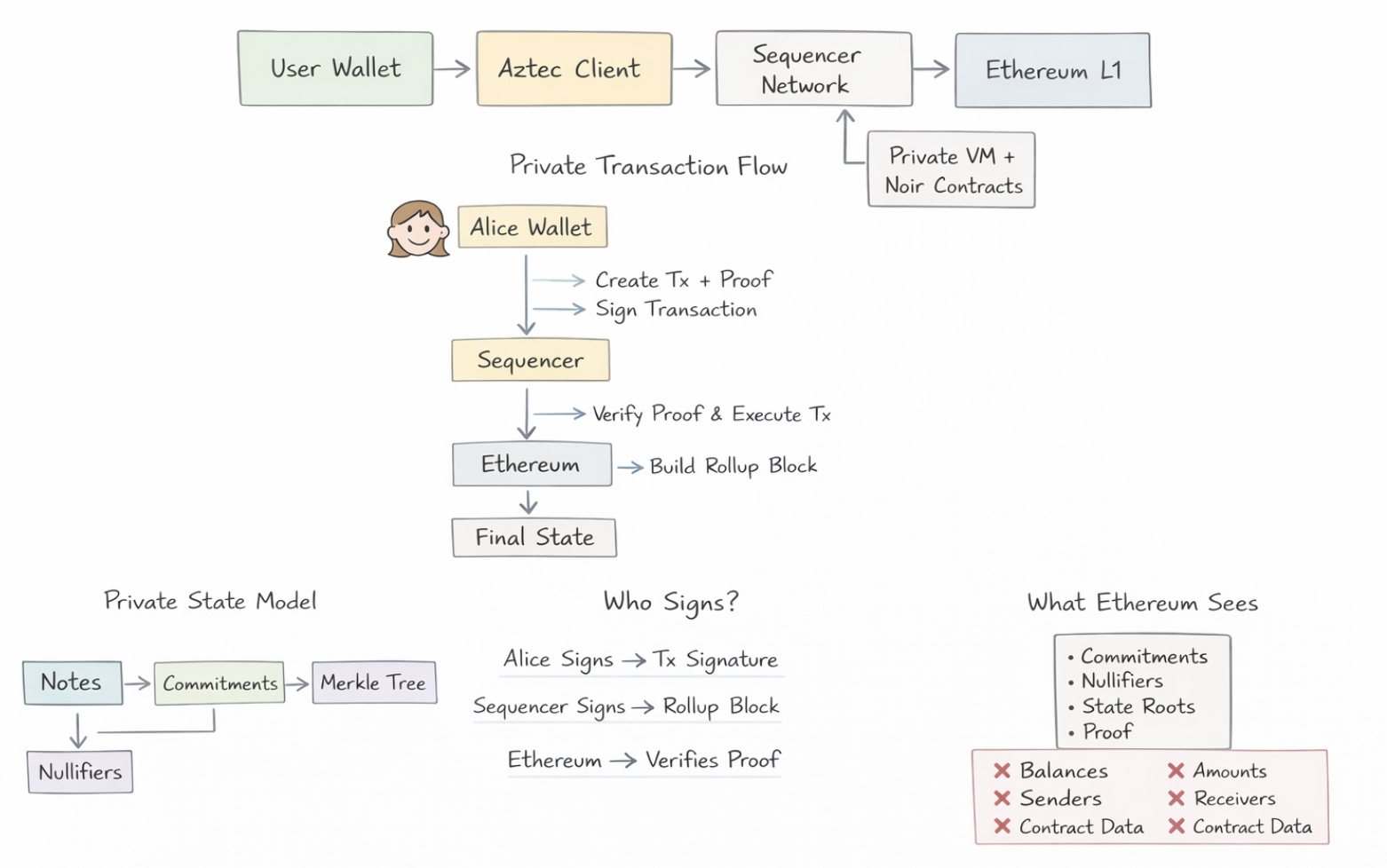
Aztec follows a rollup architecture with private execution.
There are four main layers:
1) User Wallet (Aztec Client)
This is the interface users interact with
It creates private transactions
Generates zero-knowledge proofs locally
Signs transactions
Encrypts private data
This can be a browser wallet, a mobile wallet, or an SDK integrated into an app
2) Private Execution Layer (Aztec VM + Noir)
Aztec introduces a private virtual machine that runs private smart contracts written in Noir. Execution happens off-chain, but is later proven on-chain
This layer manages:
Private balances
Private contract state
Notes (private assets)
Encrypted commitments
3) Sequencer Network
Sequencers act as block producers for Aztec. They are responsible for ordering and finalizing Aztec transactions.
It receives user transactions
Verify proofs and signatures
Execute private contracts
Build rollup blocks
Generate rollup proofs
Submit blocks to Ethereum
4) Ethereum Settlement Layer
Ethereum is the final judge that never sees private data. It only verifies cryptographic proofs.
Verifies rollup proofs
Stores state roots
Guarantees data availability
Enforces correctness
Actors & Nodes in the Aztec Network
Aztec is powered by a network of specialized nodes that together ensure privacy, correctness, and decentralization.
Each actor has a distinct responsibility in processing transactions, maintaining state, and proving rollup integrity.
1) Full Nodes: It allow users and applications to connect directly to the Aztec network. It ensure that users do not need to trust any third party to interact with Aztec. They provide censorship resistance and independent verification.
They maintain a full copy of Aztec’s state
Track private commitments and nullifiers
Serve data to wallets and apps
Relay transactions to sequence
2) Sequencer Nodes: They are responsible for producing Aztec blocks. They are selected via a proof-of-stake mechanism and act as block producers for the Aztec network. They are the backbone of Aztec’s execution layer.
They receive private transactions from users
Verify zero-knowledge proofs
Execute private smart contracts
Order transactions
Build rollup blocks
Submit batches to Ethereum
3) Provers: They generate the cryptographic proofs that guarantee correctness. Ethereum verifies these proofs before accepting a new Aztec state root. This ensures that even though execution is private and off-chain, correctness is enforced on-chain.
They take executed transactions from sequencers
Generate zero-knowledge rollup proofs
Prove that all private state transitions were valid
Produce the final proof submitted to Ethereum
Aztec’s Private Data Model
Aztec does not use account balances. Instead, it uses a UTXO-like model to ensure double-spending is impossible while ownership is private and state is verifiable. It has:
Notes: Notes represent private assets. A note is like a secret coin.
Nullifiers: When a note is spent, a nullifier is published to mark it as spent.
Commitments: Notes are encrypted and committed to a Merkle tree.
Who Signs What?
User (Alice) Signs:
Transaction intent
Note spending authorization
Contract call
This proves user consent.
Sequencer Signs:
Rollup block
Batch submission
This proves block authenticity.
Ethereum Verifies:
Rollup proof
State transition
Ethereum does not sign; it verifies
To summarize, Aztec is a privacy-preserving rollup where users execute smart contracts privately, generate zero-knowledge proofs locally, and rely on a sequencer network to batch and settle encrypted state transitions on Ethereum. It combines Zero-knowledge cryptography, Private execution, and rollup scalability with Ethereum security to deliver programmable privacy.
Thanks for reading :))
Nice read